News
13 Feb 2026
Tilda Blomqvist joins SPARC for an Erasmus+ Internship

Having graduated from Lund University in Sweden, Tilda is visting SPARC for 3 months within the Erasmus+ Internship programme. Tilda comes from an architectural background and is here to research anticipations of a building’s internal layout based on external cues (facade). Welcome Tilda!
13 Feb 2026
Funding received for a new German-Korean collaboration

SPARC and Human-Centered Interior Environment Lab led by Prof. Ji Young Cho at Kyung Hee University in Seoul have received joint funding from the German Research Foundation and the National Research Foundation of Korea. The project is titled “Measuring mental representations of complex 3D structures for wayfinding: bringing together geoinformatics Virtual Reality tools and domain-specific psychometric spatial ability tests” and will involve mutual research visits of 3-4 weeks (Jakub in Seoul, Ji Young in Münster) over the upcoming year.
05 Feb 2026
Talk on 3D Sketch Maps

Jakub was invited to give a talk at the training school of the Marie Sklodowska-Curie-UKRI Doctoral Network - “SCALA – Spatial Communication and Ageing across Languages”. The group of 16 Doctoral Candidates and their supervisors investigates how spatial communication happens across languages, age groups, and how technology can affect it. The training school was hosted in Florence, Italy at the beautiful historical building of the Montedomini Training Center. The building was sufficiently confusing to practically demonstrate the need for this line of research.
The talk sumarised the output of the 3D Sketch Maps project, as an example of how technology (in this case, VR and AR) can assist people in expressing and communicating complex spatial information.
27 Jan 2026
New publication on how architects interpret building layouts
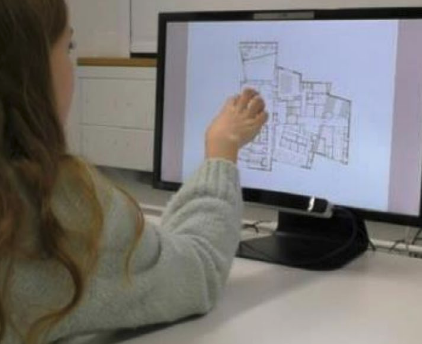
New paper, “Interpreting Architectural Drawings: The Role of Gaze and Gestures in Cognitive Offloading”, now published in Applied Cognitive Psychology (open access), coming out of the PhD thesis of Yesol Park at ETH Zürich.
It shows how architects use gaze and hand gestures as complementary strategies to offload spatial thinking - across two different interpretation tasks and types of building layouts. Abstract layouts invite exploratory looking and representational gestures; detailed layouts foster focal attention and deictic pointing.
Really loved this comment from the reviewer: “All in all, this is exactly the kind of research I would like to see more of: investigations into practical problems using a sound theoretical basis and sophisticated methods.” - this is exactly the kind of research I love doing.
Open-access paper: https://doi.org/10.1002/acp.70127
25 Nov 2025
SPARC awarded a grant to enhance mobile eye-tracking in architectural contexts
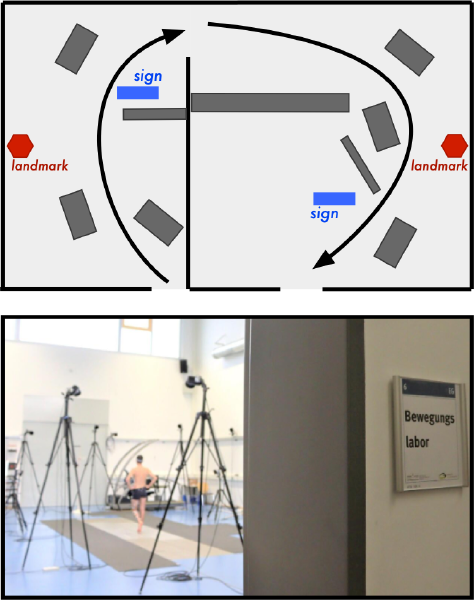
Our new 3-year project on linking walking trajectories and eye-movement trajectories has been funded by the German Research Foundation. Project SPACE-EYE: Spatial and Architectural Evidence from Movement-aware Eye-tracking will combine mobile eye-tracking and motion data to build a computational framework that models gaze and locomotion together (…of course in realistic architectural settings).
This has implications for areas interested in modelling how people move through and view space, e.g. in signage planning, or emergency evacuation scenarios.
The project will welcome a fully-funded PhD student for 3 years.
05 Sep 2025
New publication from the 3D Sketch Maps project
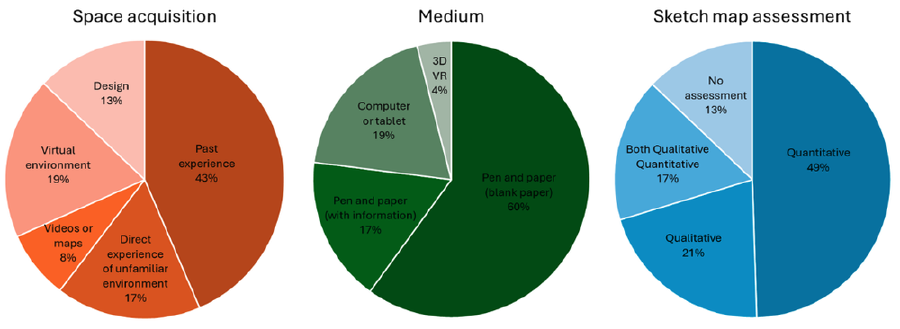
New publication from the 3D Sketch Maps project led by Marie Simonet published in Cognitive Research: Principles and Implications : Probing mental representations of space through sketch mapping: a scoping review
Our review brings together 24 studies to examine how sketch maps externalize cognitive maps of buildings, neighborhoods, and cities. We highlight both the strengths and limitations of sketch mapping—from traditional pen-and-paper to VR tools—and point to emerging opportunities.
Key findings: - There’s an intrinsic conflict: sketch maps are used predominantly in less-structured studies (real world setups, unrestricted drawing on blank paper), yet researchers predominantly use quantitative methods to analyse sketch maps. These “punish” participants for generalisations and inconsistencies that are natural in such drawings. Analysing Qualitative Spatial Relations is a way to bridge this gap. - New sketch-mapping opportunities emerge with VR and digital drawing tools. For instance, sketching vertically complex structures finally is accessible to non-expert participants.
Really enjoyed this collaboration across ETH Zürich, Münster, and beyond!
01 Jun 2025
Jung-Won Lee joins SPARC, In-and-Out project begins

Having graduated from KAIST in South Korea, Jung-Won Lee has joint SPARC to work on the project “In-and-Out: A Cognitively-Grounded Integration of Indoor and Outdoor Spatial Computing”. Welcome Jung-Won!
18 Mar 2025
Talk at ETH Behavioral Studies Colloquium in Zurich

© ETH Zurich
Jakub gave a talk at the Behavioral Studies Colloquium of ETH Zurich titled:
From spatial cognition to evidence-based architecture: Bridging psychology and design through computation
Abstract: Despite decades of dedicated research, psychological insights into how people perceive and navigate space remain largely underused in design practice. While it is impossible to submit a building that fails fire safety or construction regulations, no one really knows whether a building will perform its psychological function well until it is built and filled with people. The Spatial and Architectural Cognition (SPARC) Lab seeks to change this by integrating cognitive science, geoinformatics, and computational design. This talk will present three key challenges shaping our approach. First, spatial algorithms must capture the perceptual and cognitive factors that shape human navigation and experience. Second, generating empirical data at scale remains a bottleneck, as classical architectural studies are too slow to support design workflows and examine only a few variables at a time while in reality multiple variables always interact. Third, realising evidence-based design requiers automated methods for translating insight from research papers into concrete functions in architectural software.
Thank you to Prof. Christoph Hoelscher for the invitation and to such a large audience for their interest and great discussion!