SPACE-EYE
Spatial and Architectural Evidence from Movement-aware Eye-tracking
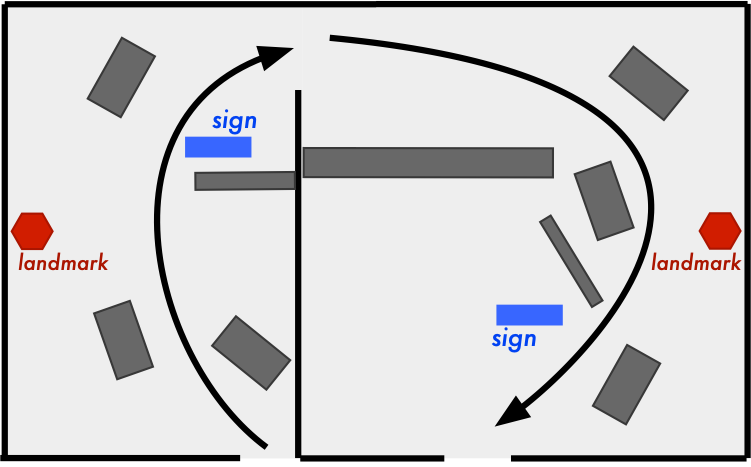
Current models of human–building interaction either analyse visual attention independently of movement, or reduce movement to a fixed field of view aligned with walking direction. This artificial separation leads to research results that are often trivial and therefore underused in practice. SPACE-EYE integrates theories of visual attention — visual saliency, the perception–action loop, embodied attention — with movement data, and develops a computational framework that models gaze and locomotion jointly.
The central question is: what is the impact of movement through space on the visual-attention measures used in human–building interaction modelling?
This project bridges two disjoint bodies of theory — movement and visual attention — and addresses a known limitation of architectural simulation algorithms: their lack of embodiment. Outputs are intended to be reusable by architectural cognition, spatial HCI, geoinformatics, and architectural design.
Funding: German Research Foundation (Project number 570734475); €380k+
- Posted on:
- April 1, 2026
- Length:
- 1 minute read, 141 words
- See Also: